Tyson rEEDER
First off, can you say a little bit about how you first became interested in painting and how the practice has developed and changed over the years?
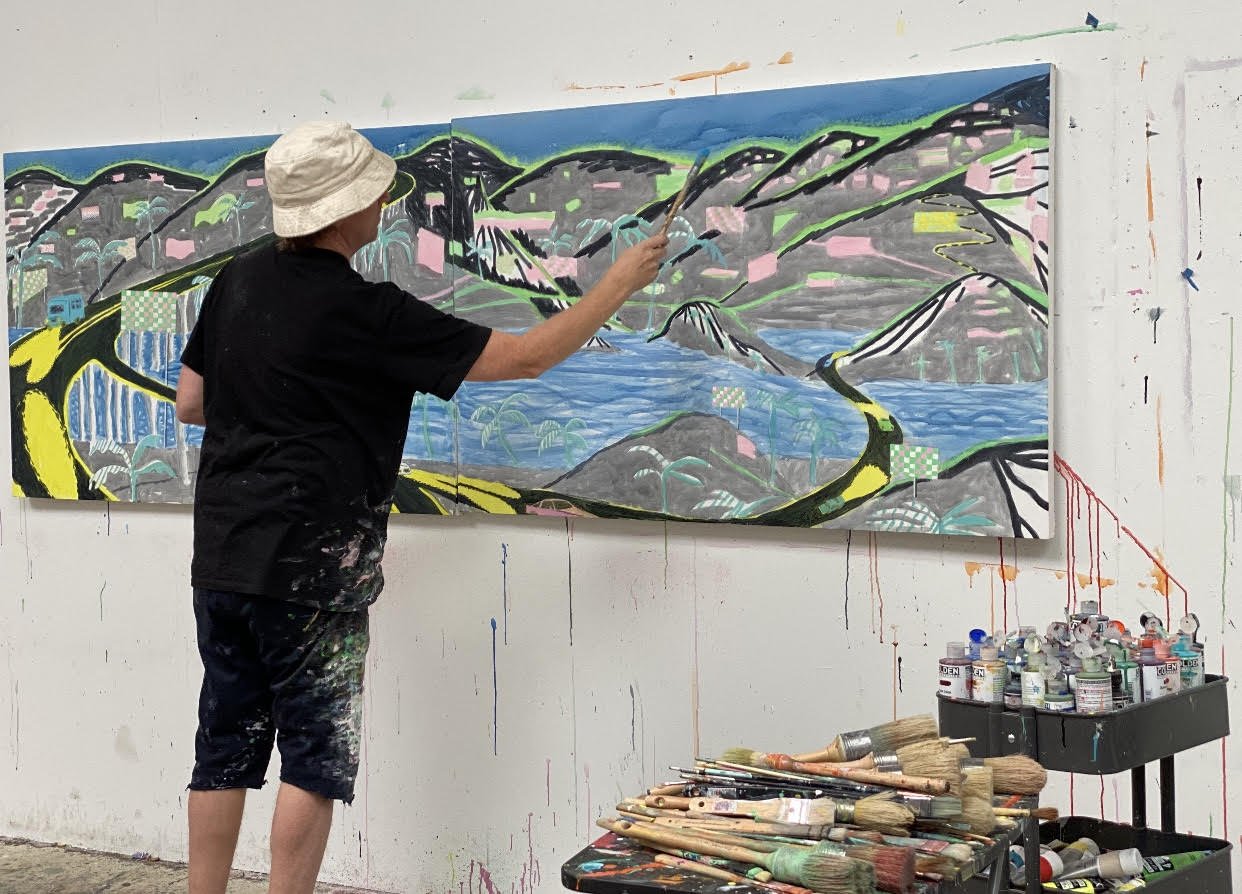
All the painters I care about describe being mystified by the drifts and detours of their own work, and now I get it. It’s sort of a blur. There’s a linear story there somewhere, but it unfolds more like a game of telephone where a new painting may be a mutation of an old painting, but I couldn’t tell you exactly how. I just saw Carroll Dunham speak on the occasion of a survey of his drawings at the Art Institute of Chicago and he spoke about the entirety of his drawing practice being like evolution, where certain ‘species’ of drawings fall away and others are able to thrive. That made sense to me.
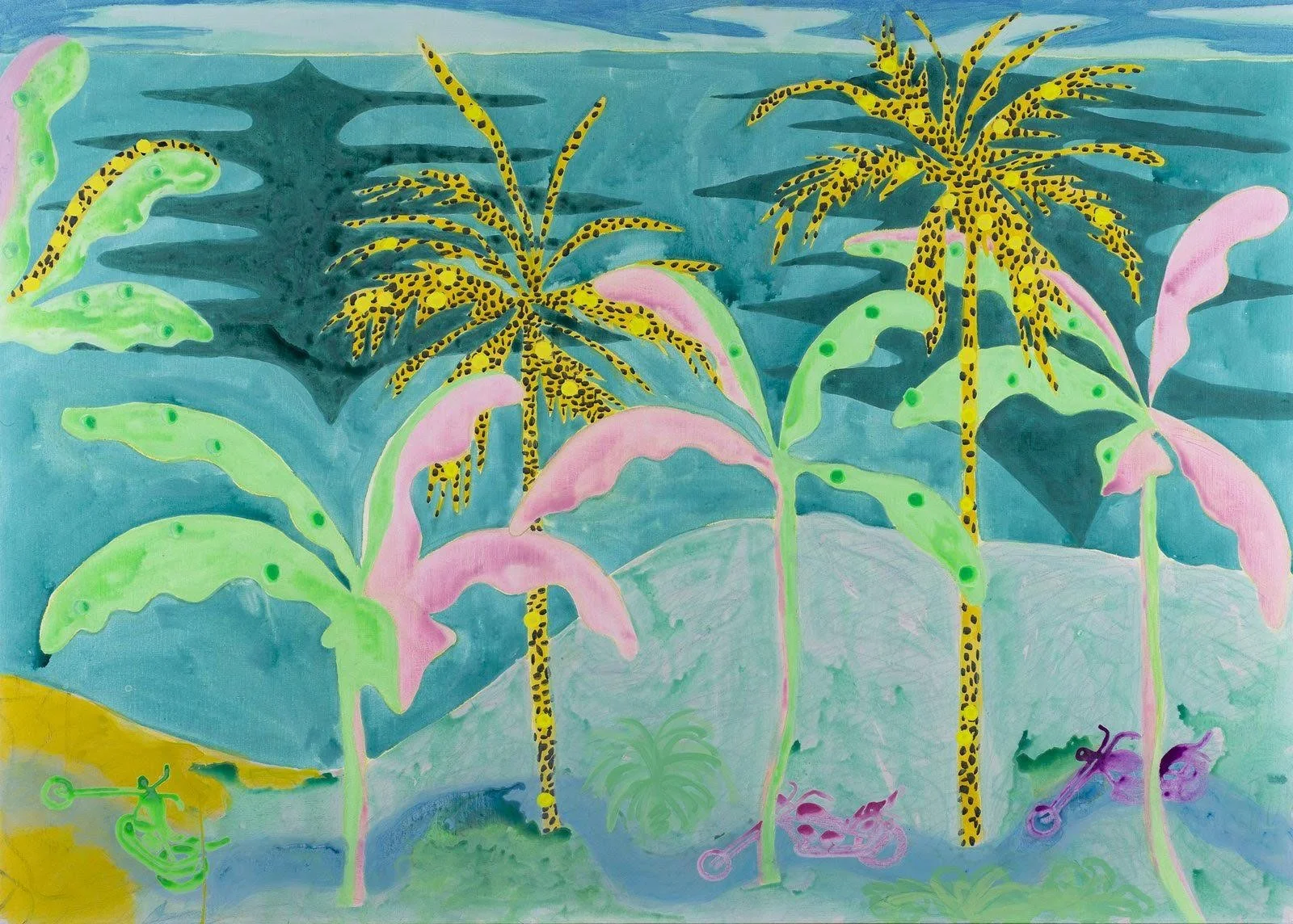
Autobahn, 2019, acrylic and graphite on linen, 50 x 70 in
I started out showing works on paper in the mid-2000’s at Daniel Reich Gallery in Chelsea, a short-lived but impactful apartment space on 21st that stood in stark contrast to the airplane-hangar sized white cubes being erected around it. The intimate space and the community of artists around it influenced the work. I was making hallucinatory landscapes and constellations of tiny index card drawings made with cheap drugstore materials – nail polish, fabric dye, sharpies, glitter- while artists like Christian Holstad were knitting elaborate installations around Daniel’s futon, and music/art collectives like Dearraindrop and Paperrad were collaborating on collages and zines. Jerry Saltz called this ‘ termite art ’, a way of collectively eating away at the old guard through smaller, unmonumental works and actions.
These early aesthetic run-ins are imprinted on my DNA. I’m still chasing a kind of lightness, in subject and form, when addressing a canvas or panel. If some painting is engaged with filling up a work with the weight of history or the complexity of lived human experience, I’m always trying to drain it out to get to something more like a poster or a sticker. Hence the dumb subject matter – motorcycles, palm trees, fashion, malls – and the thin synthetic acrylic color, which I’m told looks like a highlighter marker or slurpee.
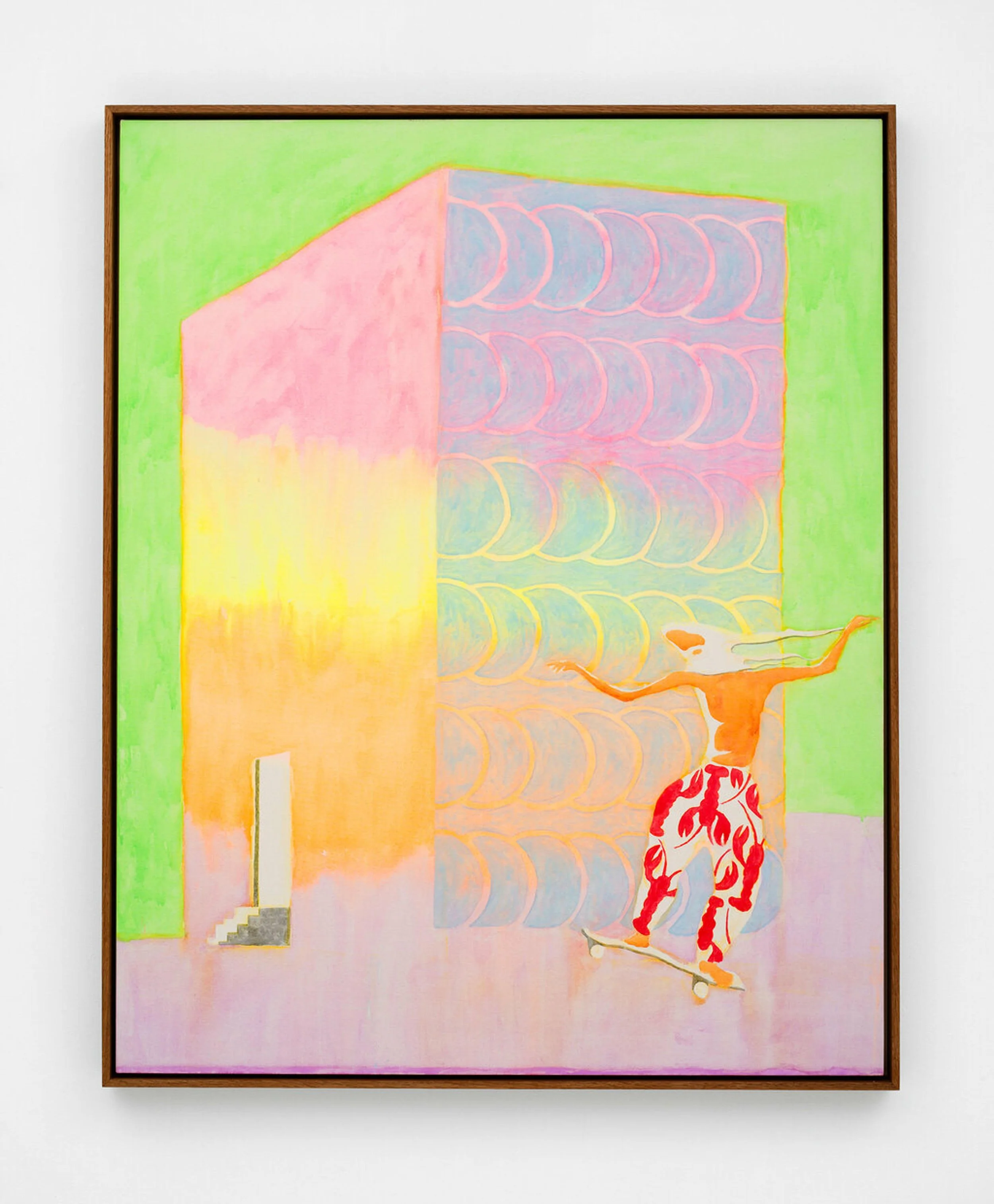
Lobster Sweatpants, 2024, acrylic on canvas, 36 x 35 in
Both Christina and I (Ish) really appreciated that while we were in grad school during COVID, you organized events like Bubbles, the art gallery in a fish tank (where an exhibition would take place for a few hours, live-streamed from the fish tank), and would open up your studio. At a time when social events were increasingly dispersed, this really helped to foster a sense of community. You and your brother Scott have been organizing events like this for years, like Dark Fair, Drunk v Stoned at Gavin Brown, and the Club Nutz. How did some of those projects come about, and what were some of the difficulties and enjoyments of working on them?
Painting and writing are some of the last remaining professions that are truly solitary – it’s just you and your deadline. I love that, but it comes with its own minefield of tired archetypes and cliches. I’ve been fortunate to have a collaborative spark within my family that I can keep returning to when I hit one of the many walls out there. Narcissism is a big one. There’s so much “ I” in being an artist. It’s nice to be able to say “ we” sometimes.
I might describe our curating style as “ What if….?” curating. Rather than a last word on a given group of artists, it’s maybe a first word, a proposition. In the dark? Underwater? On ice? The same art, but with the context flipped. There’s a long history of artists giving curating an inspired go. For the Dark Fair, we took inspiration from Duchamp’s 1942 exhibition “First Papers of Surrealism”, in which he exhibited a greatest hits of European surrealist painting in the dark, candlelit, and covered with a mile of string.
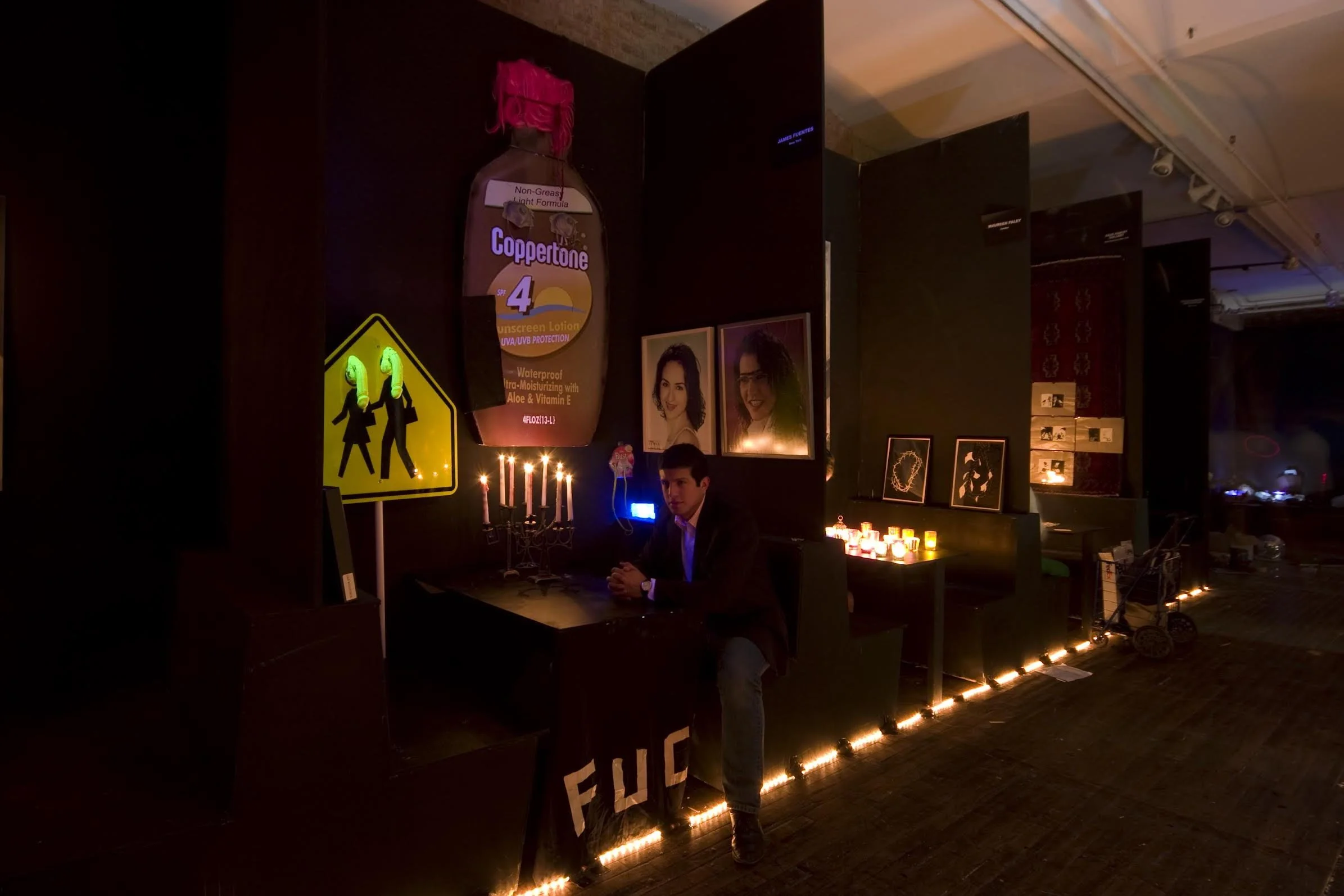
Dark Fair, Swiss Institute, New York
Bubbles, the fish tank gallery, was an iteration of our show ‘Submerging Artists’, part of Rob Pruitt’s Flea Market at Gavin Brown’s booth at Frieze, London in 2009. Real sculptures underwater – from Rachel Harrison, Donald Baechler, Mary Heilman, Olaf Breuning, and more! – with live fish swimming around them. You mentioned it functioning as a kind of lifeline when the Chicago art world had shut down, and that’s true. With co-curating from LA artist Lauren Sullivan, it became a kind of primordial transition back into the real world, with artists like Liza Jo Eilers and Cameron Spratley going all-out for their first underwater solo show. Like our other projects, it was a blind leap of faith. If you set up an original social context, people will come. We all need new ways to experience visual art, and good ideas can come from anywhere.
Some difficulties? Fish don’t like loud DJ music.
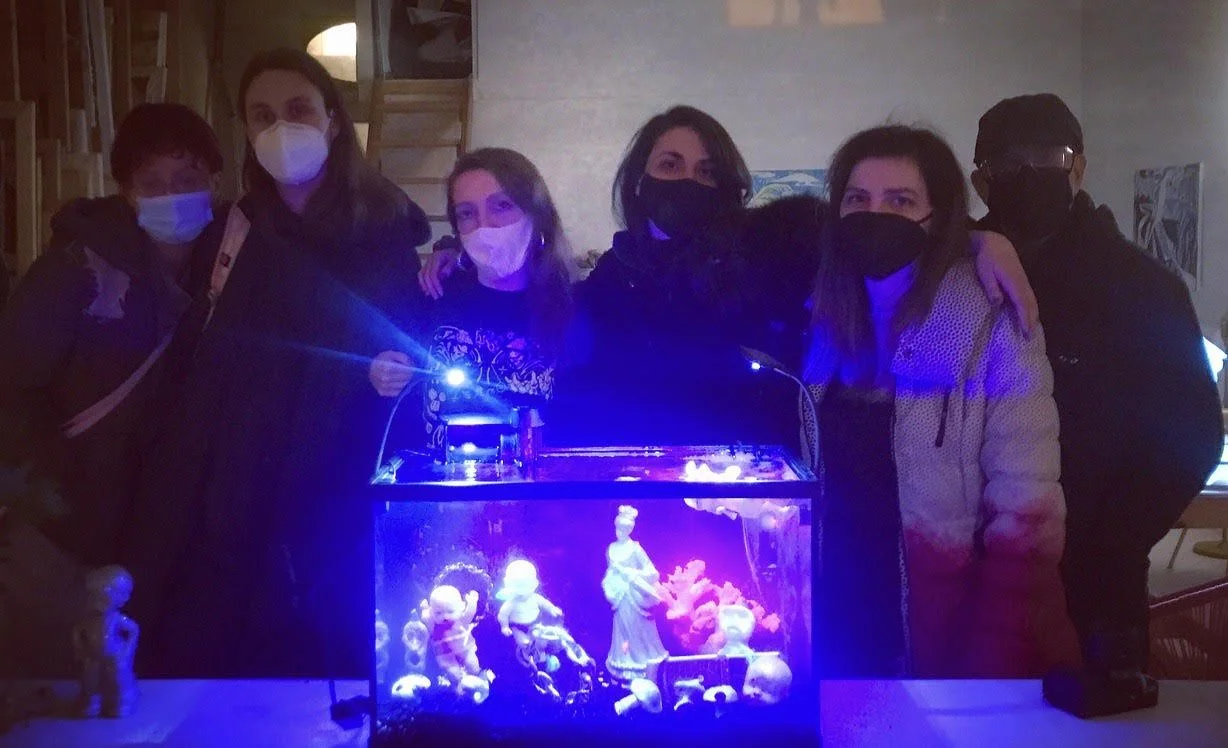
Bubbles, Chicago
Drunk v stoned in a way mirrors your own art practice, where you have a rigorous sense and love of art history, but are also not opposed to welcoming in a playful energy. Has this levity been something you have actively developed and protected while still engaging with the art world?
For Drunk vs Stoned, we took the dictionary definitions of drunk, “lowered inhibitions”, and stoned, “heightened sensitivity”, as a lens through which to view all visual art. In the first two iterations, presented in collaboration with Gavin Brown’s Enterprise in New York, fast and loose works by artists including Franz West, Charlene Von Heyl, Martin Kippenberger, and Sarah Lucas were installed in a face-off across the space with more cerebral and myopic work by Henri Michaux, Yayoi Kusama, and Charles Ray, among others. Sculptures by Rachel Harrison, which in a way embody both sensibilities, were installed in the middle of the room
Part three, in collaboration with Max Levai’s Montauk space, The Ranch, added more voices to this conversation. Hard-edged, hyper-detailed works by Jamian Juliano-Villani, Borna Sammak, and HR Giger were hung with rough, tactile work by Mike Cloud, Sophie Von Hellerman, RJ Messineo, and Rachel Eulena Williams, with many falling somewhere in between. All versions of this exhibition featured a raucous soccer game where participating artists went at each other in one of the two mind states.
These forces might be fighting it out in my current painting practice a bit. I tend to begin with impulsive bursts of nonsense – embracing chance and getting lost in materials through spills, washes, and loose drawing – and end with a lot of fretting and tinkering with the details. I heard a musician give this advice: “ Play like a child, then edit like a scientist. “
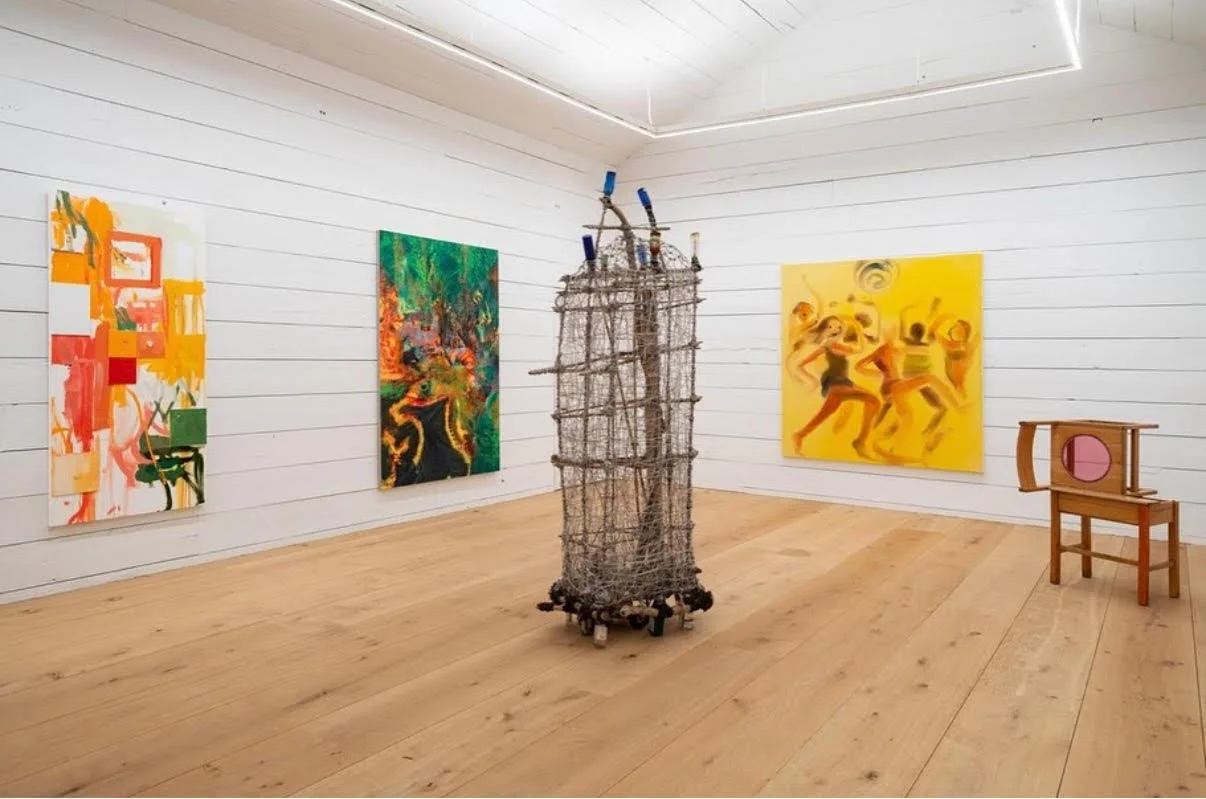
Drunk vs Stoned 3, The Ranch, Montauk, NY. Left to right: RJ Messineo, Lucy Bull, Arthur Simms, Sophie Von Hellerman and Sarah Braman
What advice would you give to artists who may want to start their own projects and curatorial ventures?
I would encourage any young artist in 2026 to be deeply skeptical of the comforting and frictionless version of community building that has been sold to them by IG. Start a physical space or an inclusive event while you have the extra energy. It doesn’t matter if it lasts one night or ten years. This simple, selfless gesture of platforming others will karmically come back to you when you need it most.
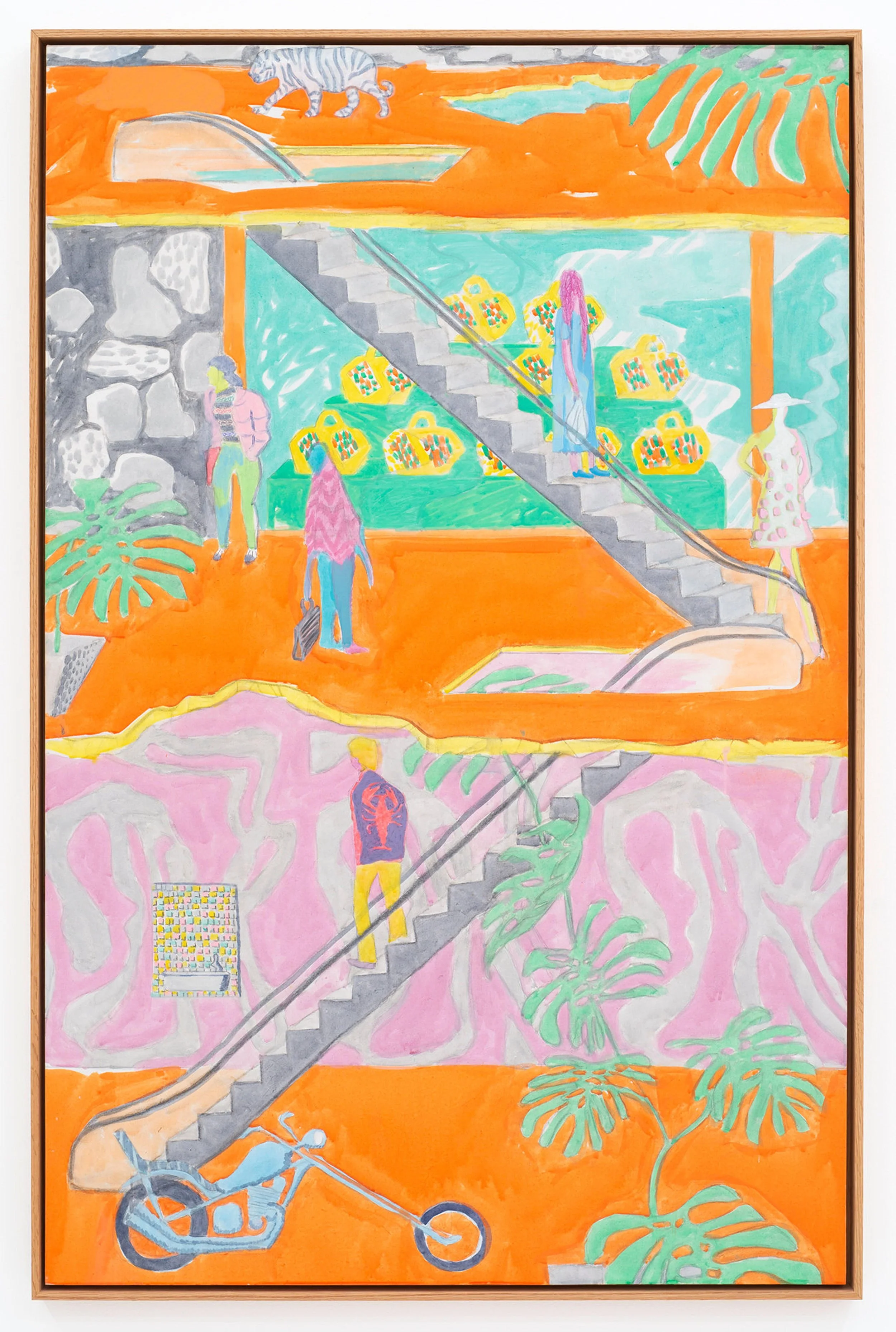
OC, 2020, Acrylic and graphite on canvas, 57 1/4 x 37 1/4 in
How have you managed a balance between organizing these events while still painting?
I think the collaborative nature of the events creates their own collective momentum and can be weirdly efficient once we get going. Our shared community of artists is larger than what we could pull off individually, so we take turns reaching out to artists, drafting the press release, and installing the work. That’s when it feels symbiotic – the relationships formed in the curating can sometimes reframe the work in the studio and open doors that I would never have known existed if I had just been staring at my own rectangles.
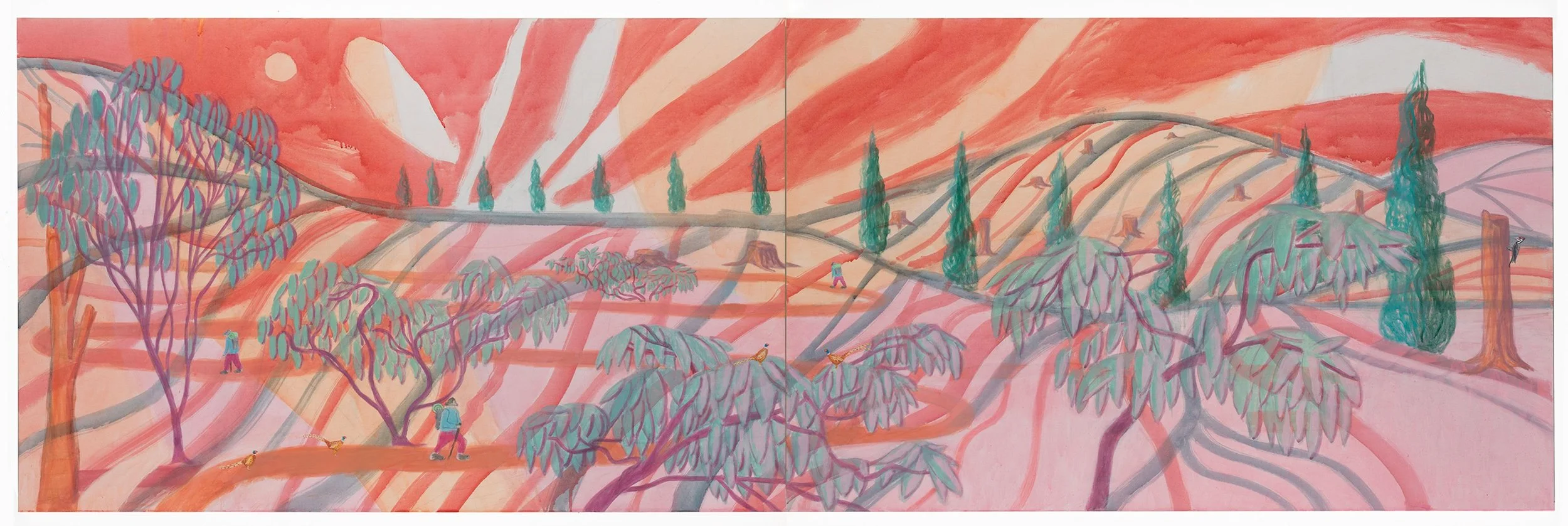
Carabiner , 2020, acrylic on canvas, 36 x 112 in
